
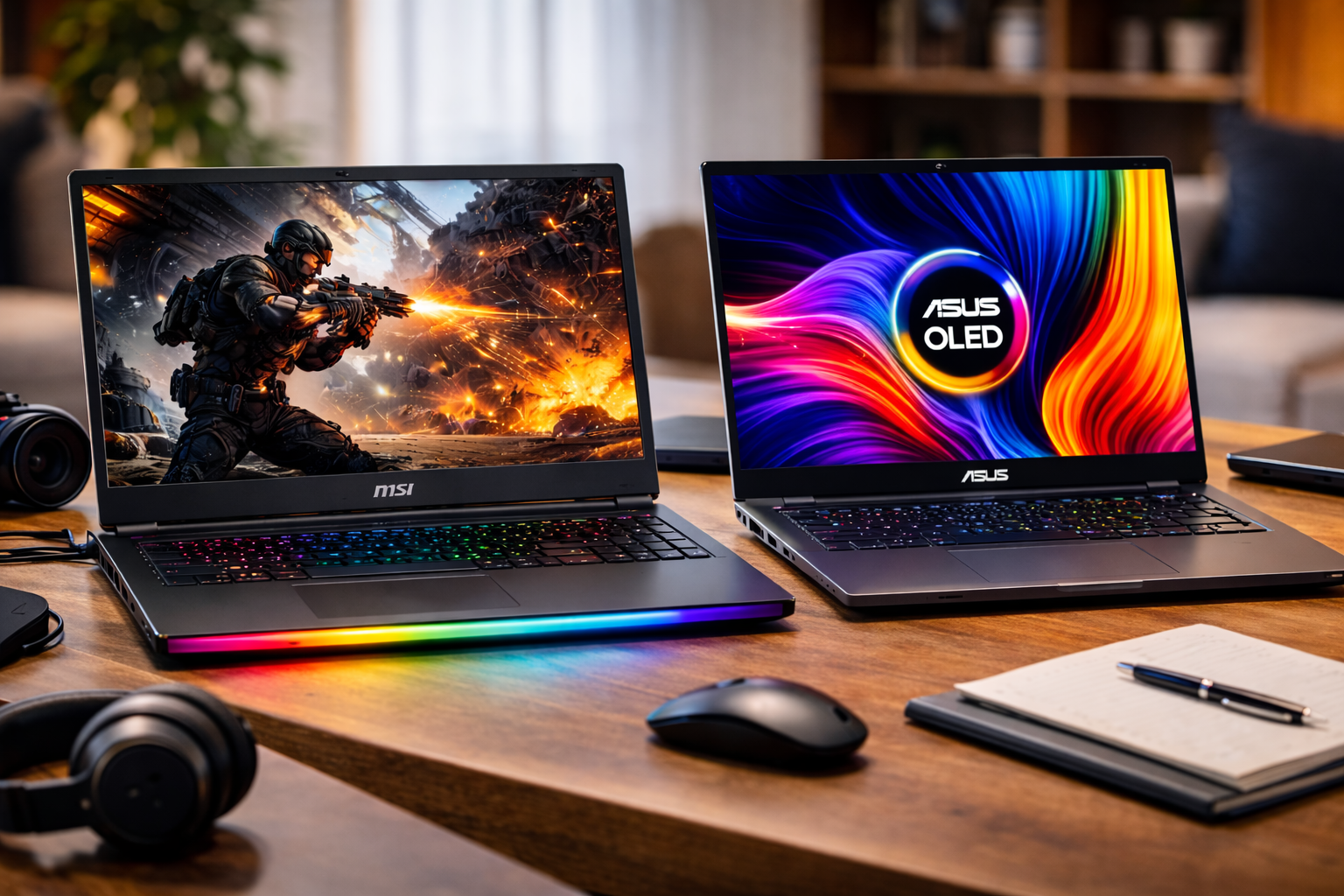
Short answer first: MSI and ASUS differ mainly in design philosophy, performance tuning, target audience, and product focus. MSI emphasizes raw performance and gaming power, while ASUS balances performance with versatility, design variety, and broader consumer appeal.
Both brands are respected in the laptop market. However, they approach engineering and user experience in noticeably different ways. Understanding these differences helps you choose the right laptop based on your needs, not just brand reputation.
Introduction
Choosing between MSI and ASUS depends on performance, design, and usage priorities.
Brand Identity and Core Focus
MSI built its reputation on high-performance gaming hardware.
Its identity centers on power, speed, and enthusiast-level performance.
ASUS, on the other hand, offers a wider range of products.
It serves gamers, students, business users, and casual consumers.
This difference shapes how each company designs laptops.
MSI focuses heavily on:
- Gaming performance
- High-end hardware
- Cooling efficiency
ASUS focuses on:
- Versatility
- Design variety
- Balanced performance
These philosophies influence everything from pricing to user experience.
Performance Philosophy: Power vs Balance
MSI laptops often push hardware closer to its limits.
This approach delivers strong performance, especially in gaming and creative workloads.
MSI typically allows:
- Higher CPU wattage
- Strong GPU performance
- Sustained performance under load
ASUS takes a more balanced approach.
ASUS laptops often:
- Optimize for efficiency
- Limit extreme thermal output
- Balance power with battery life
This means MSI laptops often outperform ASUS models in raw power.
However, ASUS laptops may feel more efficient in everyday use.
Gaming Laptop Design Differences
Both MSI and ASUS produce gaming laptops, but their design styles differ.
MSI Gaming Design
- Bold and aggressive styling
- RGB lighting features
- Large cooling vents
- Performance-focused chassis
ASUS Gaming Design
- More variety in design
- Options ranging from subtle to aggressive
- Sleeker profiles in some models
ASUS offers more aesthetic diversity.
MSI sticks closer to a performance-driven identity.
Cooling Systems and Thermal Performance
Cooling is one of MSI’s biggest strengths.
MSI laptops often include:
- Larger heat pipes
- Multiple fans
- Aggressive cooling profiles
This allows MSI laptops to maintain performance during long sessions.
ASUS cooling systems are also effective but often prioritize quieter operation.
Key differences include:
- MSI prioritizes cooling performance
- ASUS balances cooling with noise control
This results in MSI laptops running louder but more consistently under heavy load.
Build Quality and Materials
Both brands offer solid build quality, but they approach it differently.
MSI laptops:
- Focus on durability under stress
- Use reinforced designs for gaming
- May feel heavier due to stronger builds
ASUS laptops:
- Offer more lightweight options
- Include premium materials in ultrabooks
- Focus on portability and aesthetics
Neither brand is inherently better.
The choice depends on whether you value strength or portability.
Weight and Portability
MSI laptops are generally heavier.
This is due to powerful components and larger cooling systems.
ASUS provides more lightweight options, especially in ultrabook lines.
If you travel frequently, weight matters significantly.
MSI suits users who prioritize performance.
ASUS suits users who prioritize mobility.
Battery Life Comparison
Battery life is a major difference between the two brands.
MSI laptops often have shorter battery life, especially gaming models.
ASUS tends to optimize for efficiency, resulting in longer battery performance in many models.
If battery life is important for your workflow, it’s worth exploring Do MSI laptops have good battery life for travel? to understand how MSI performs in mobile environments.
Understanding battery expectations prevents disappointment.
Product Line Variety
ASUS offers a broader product range.
ASUS lineup includes:
- Gaming laptops (ROG series)
- Ultrabooks (ZenBook)
- Business laptops (ExpertBook)
- Budget-friendly devices
MSI lineup is more focused.
MSI emphasizes:
- Gaming laptops
- Creator laptops
- High-performance systems
ASUS serves a wider audience.
MSI focuses on performance-driven users.
Target Audience Differences
MSI primarily targets:
- Gamers
- Content creators
- Developers
- Power users
ASUS targets:
- Students
- Professionals
- Gamers
- General consumers
This difference explains why ASUS laptops appear in more categories.
MSI remains specialized in high-performance niches.
Display Technology and Quality
Both brands offer high-quality displays.
MSI focuses on:
- High refresh rates
- Gaming responsiveness
- Creator-focused color accuracy in select models
ASUS offers:
- OLED display options
- Balanced brightness and color accuracy
- Wider display variety
ASUS leads in display diversity.
MSI focuses on performance-oriented displays.
Keyboard and User Experience
Keyboard design affects daily usage.
MSI keyboards:
- Focus on gaming performance
- Include RGB lighting
- Offer solid tactile feedback
ASUS keyboards:
- Focus on comfort and versatility
- Offer quieter typing experience
- Include ergonomic layouts
Gamers may prefer MSI keyboards.
Office users may prefer ASUS keyboards.
Software and System Control
MSI provides performance control software.
Users can:
- Adjust fan speeds
- Control system performance
- Customize hardware settings
ASUS also offers system control tools but often emphasizes ease of use.
MSI gives more control to advanced users.
ASUS offers a more user-friendly interface.
Pricing and Value
Pricing varies between the two brands.
MSI often provides strong performance for the price.
This makes it attractive for gamers and creators.
ASUS offers more pricing tiers, including budget-friendly options.
ASUS may offer better value for general users.
MSI offers better value for performance-focused users.
Reliability and Longevity
Both brands produce reliable laptops.
Reliability depends more on:
- Usage
- Maintenance
- Model quality
MSI laptops excel in sustained performance.
ASUS laptops excel in efficiency and balance.
Neither brand has a clear universal advantage.
Gaming Experience Comparison
For gaming, MSI often leads in raw performance.
Benefits of MSI gaming laptops:
- Higher frame rates
- Better thermal stability
- Strong GPU performance
ASUS gaming laptops offer:
- Balanced performance
- Quieter operation
- Better portability in some models
Serious gamers often lean toward MSI.
Casual gamers may prefer ASUS.
Content Creation and Professional Use
Both brands support creative workloads.
MSI stands out for:
- GPU power
- Rendering performance
- Cooling stability
ASUS stands out for:
- Display quality
- Battery life
- Lightweight designs
Creative professionals should choose based on workflow needs.
Which Brand Should You Choose?
Choosing between MSI and ASUS depends on priorities.
Choose MSI if you want:
- Maximum performance
- Strong gaming capability
- Reliable cooling
Choose ASUS if you want:
- Better portability
- Longer battery life
- Wider product options
Understanding your needs is the key to making the right decision.
Final Thoughts
MSI and ASUS are both strong laptop brands with different strengths.
MSI focuses on performance and power, making it ideal for gamers and creators who need high-end hardware.
ASUS offers versatility, making it suitable for a broader range of users.
The best choice depends on how you plan to use your laptop.
Understanding these differences ensures you invest in a device that fits your lifestyle and workload.
Summary
MSI and ASUS differ in performance philosophy, design focus, and target audience. MSI prioritizes power and cooling, making it ideal for gaming and demanding tasks. ASUS emphasizes versatility, portability, and efficiency, appealing to a wider audience. Choosing between them depends on whether you value raw performance or balanced everyday usability.